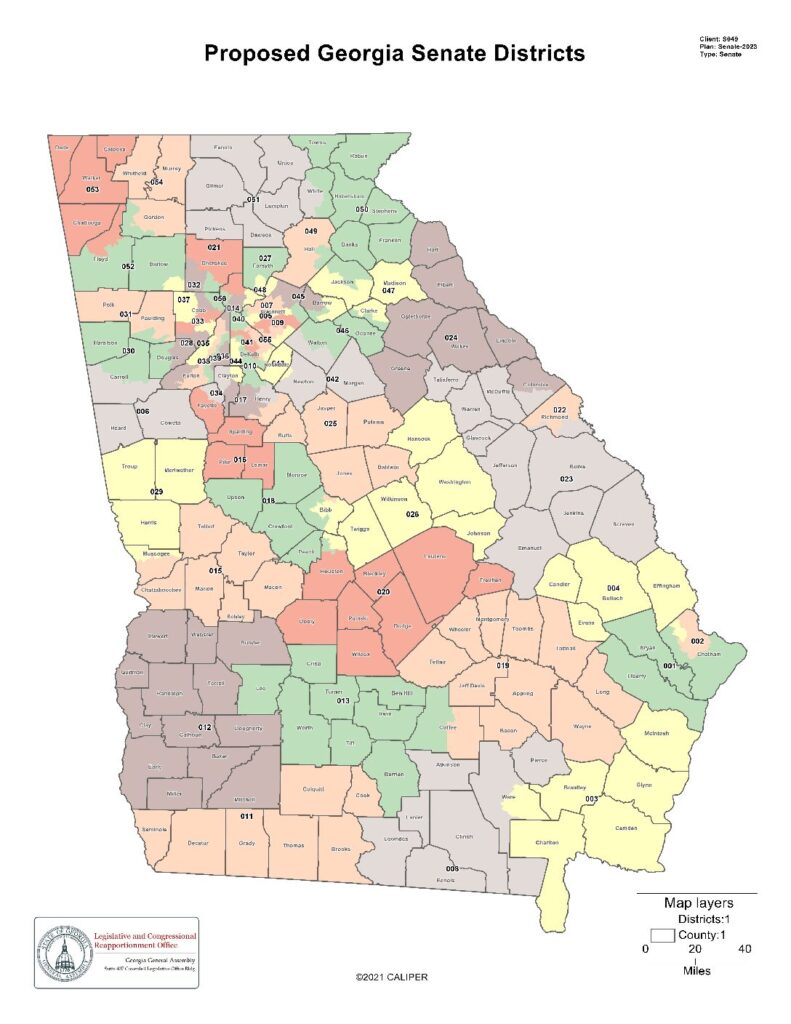
A proposed state Senate redistricting map released Monday would create two additional Black majority districts in the General Assembly’s upper chamber in keeping with a federal court order.
Senate District 17 in Henry and Newton counties and Senate District 28 in Douglas and Fulton counties would become majority Black under the proposed map, released two days ahead of a special legislative session on redistricting beginning Wednesday.
The addition of two Black majority state Senate districts would comply with a ruling U.S. District Judge Steve Jones handed down last month that found the congressional, state House and state Senate redistricting maps the Republican-controlled General Assembly drew two years ago in violation of the federal Voting Rights Act.
Jones also ordered state lawmakers to add five Black majority seats to the Georgia House and one Black majority seat to the state’s congressional delegation.
Currently, Republicans hold 33-23 and 102-78 advantages in the state Senate and House, respectively. The GOP holds nine of Georgia’s 14 U.S. House seats.
The 17th Senate District is currently served by Republican Brian Strickland of McDonough, chairman of the Judiciary Committee. The 28th Senate District is currently represented by the GOP’s Matt Brass of Newnan, chairman of the Rules Committee.
Jones’ ruling ordered Black majority legislative and congressional districts added in portions of metro Atlanta that have seen dramatic growth in Black residents in recent years.
Under the proposed map, the voting-age population of Strickland’s 17th Senate District would go from 59.4% white to 61.8% Black. That would be accomplished by shifting the district’s boundaries westward to take in a large portion of majority-Black Clayton County.
Changes to the 28th District would be more significant. The district Brass now serves would be shifted northward out of Coweta County to include southwest Fulton County, eastern Douglas County, and southern Carroll County.
The voting-age population of the 28th Senate District would go from 69.4% white to 54.1% Black.
The proposed map also would modify 13 other Senate districts from their current boundaries. Eight of those districts would remain majority Black, while five would remain majority white.
The lawsuit that led to Jones’ ruling pointed to a 2020 Census that showed all of Georgia’s population growth during the decade of the 2010s was among people of color, while the state’s white population declined. However, that minority population growth was not reflected in the redistricting maps the legislature drew in 2021, the plaintiffs argued.
The proposed Senate map will be followed later this week by draft maps for Georgia’s state House and congressional districts. Lawmakers must approve new district lines by a week from Friday, the deadline Jones set for them to finish their work.
Appellate court upholds statewide PSC elections
A federal appellate court has upheld the method Georgia uses to elect members of the state Public Service Commission (PSC), reversing a lower-court ruling.
In a decision handed down late last week, the 11th Circuit U.S. Court of Appeals endorsed the system of electing the five commissioners statewide rather than by district.
A lawsuit filed by four Black Fulton County residents had argued that electing the commissioners statewide diluted Black voting strength in violation of the federal Voting Rights Act, making it more difficult for Black voters to elect a candidate of their choice. Specifically, the suit targeted a map of the PSC districts the General Assembly’s Republican majorities approved last year.
The state argued that have a statewide body in charge of regulating energy in Georgia would avoid provincialism. On Friday, the appellate court agreed in a 34-page ruling.
“If each commissioner represented only a district, then important questions of utility regulation – such as the location of energy and infrastructure – could turn into a zero-sum game between commissioners beholden to their districts instead of a collaborative effort to reach the best result for the entire state,” the three-judge appellate panel wrote.
The decision would appear to clear the way for elections to the PSC, which have been on hold while the case was pending.
The terms of two commissioners – Tim Echols and Fitz Johnson – expired at the end of last year, but the two were allowed to continue in their seats.
Dave Williams writes for Capitol Beat News Service