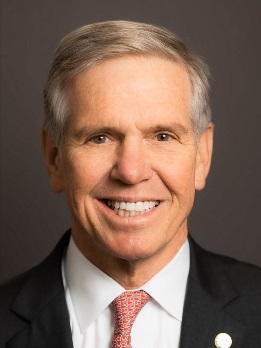
State Rep. Bruce Williamson
Through my career in public service, my focus has been facilitating business and industry in Georgia. Economic growth spreads prosperity, and I firmly believe government’s role is to step out of the way and allow entrepreneurs and corporations to do what they do best.
The result is more economic activity, better job opportunities, and a higher tax base to conduct basic civic functions. When government regulations are too onerous, the results are diminished for all. The same is true when competition leaves a marketplace. A proposed merger between two of America’s biggest railroads will reduce competitive rail shipping options. We need to understand what that would mean for our Georgia industries and families already paying higher prices for groceries, gas and other goods.
Competition serves as natural enforcement for companies to offer their best price and most efficient service. Fewer companies competing for customers translate into less leverage and almost always higher prices. Look at your cable or cell phone bill for evidence. That’s not to say consolidation is all bad. Often, businesses need to combine to survive. But when the combination isn’t to ensure a service or product remains viable, or to keep a business from going under, one must see the motivation is likely higher profits for company owners, and rarely in the best interest of paying customers.
So, it seems is the case with the consolidation plan for two large American railroads. Georgia is home to one of them, Norfolk Southern Railway. So why would this be problematic for our state? Three main concerns should be considered with this plan.
First, taking away one major railroad, which is headquartered here in Atlanta, and merging it with the Union Pacific railroad will immediately make our ports and rail shippers more reliant on a new company more than twice the size of its competitor in the state. With that market power and a coast-to-coat reach, the new UP-NS railroad could dictate price and routing options. Would other ports be favored over our Georgia ports? We already know Atlanta isn’t the favored location for its combined headquarters.
That brings the second reason this merger is concerning. It’s been stated publicly that UP will retain its office in Omaha, NE, and corporate jobs feeding the Atlanta and statewide economy will be relocated. Some will stay in Atlanta as a smaller “hub” for the merged company, but for how long and at what cost to our economic engine? Good jobs bring benefits to all sectors of the economy, from housing to the service industry.
The third challenge is who else gets left behind under a massive, merged railroad. At the core, the merger proposal is a grab to move more intermodal freight. UP has been up front that the goal is to capitalize on Norfolk Southern’s strong intermodal business, which has suited us well, and to take more freight from trucks and move it on their railroad. Rail containers and trailers full of consumer-purchased items like clothes and TVs are a welcome sight, and we are proud of our multimodal infrastructure that moves goods from ports to rail to truck for business and industry and ultimately consumers. Yet, we also need to remember all the other carloads moved by railroads are also important to our economy. Aggregates like crushed stone and sand, lumber and paper products, the things used to manufacture and build Georgia, all rely on railroad transportation.
If this merger proceeds, those industrial rail carloads are at greater risk for being held hostage, forced to pay for the merger through higher rail rates, while also seeing fewer options on shipping routes potentially not favored by the bigger railroad.
Railroad mergers must be approved by the federal Surface Transportation Board. Among the considerations by the Board is whether competition in the rail industry would be increased. The question isn’t whether this federal agency decision would be an overreach of regulation on the industry; it’s whether competition in the rail industry would flourish or be diminished. For Georgia, the answer is clear: a combined UP-NS would mean our ports, our products, and our people have fewer options and likely higher prices. “
State Rep. Bruce Williamson (R-Monroe) is the Georgia House Republican Caucus chairman.