
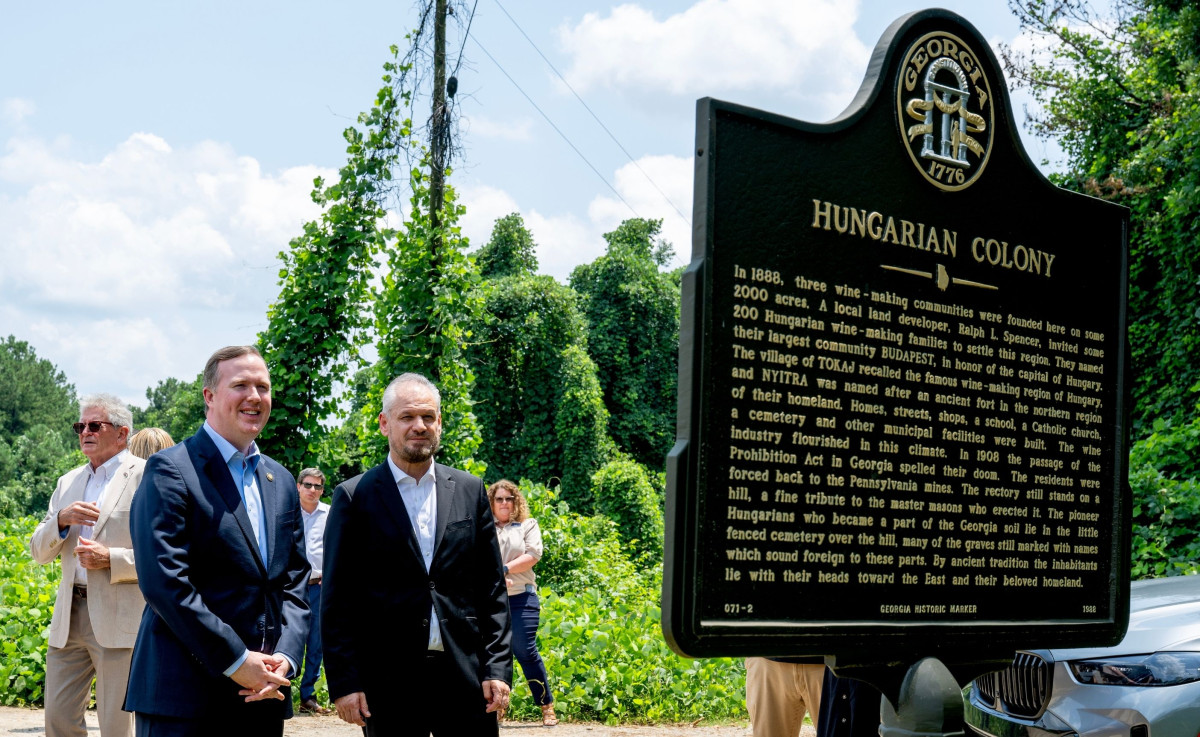
U.S. Rep. Brian Jack (left) and Hungarian Ambassador Szabolcs Takács visit the site of the former Hungarian colony in Haralson Co.
On Tuesday, U.S. Rep. Brian Jack hosted Hungarian Ambassador Szabolcs Takács on the last leg of his U.S. tour, showing him a little-known slice of Georgia/Hungarian history right where you’d least expect it – Haralson County, west of Atlanta on the Alabama border.
Some backstory for the history buffs: In 1888 local real-estate developer Ralph L. Spencer invited some 200 Hungarian families from Pennylvania mining towns to settle on land he owned in Haralson County as part of a wine-making venture. Led by a Catholic priest, Father Frances Janisek, they founded three settlements, the largest of which, Budapest, (named of course after the Hungarian capital) flourished into a town with sixty buildings, including a church, stores and a post office.
Soon, the sloping hills were covered in grape vines, as storage vats were prepared and wine production wound up, with west Georgia primed to become the nation’s newest corner of the wine industry. But disaster struck in the form of the passage of the Georgia Prohibition Act of 1907, putting an end to the burgeoning industry and a devastating blow to the growing towns. One by one the Hungarian families departed, many returning to the northeast, with only a few families remaining.
The pioneer Hungarians who died in Georgia during that time remain buried to this day in the Budapest Cemetery, outside Tallapoosa, which Jack and Takács visited as part of their tour. The bodies interred there, per Hungarian tradition, are buried with their heads pointed east, towards their ancestral homeland. They also visited ‘Key’s Castle,’ a historic stone mansion that was originally built in the late 19th century as a Catholic rectory for the Hungarian community. It was later given its nickname due to a rumor that a relative of Francis Scott Key lived there, and is also said to be one of the most haunted locations in Georgia. Who knew Haralson County had so much history to explore!
While some Hungarian families have persisted in Georgia to this day, it is only a scant fraction of those who briefly set up their Peach State colony, a memory of what could have been had prohibition not cut their stay short. A warning of the perils of overregulation, perhaps, or an ode to a northwest Georgia wine industry that wouldn’t reemerge for another two centuries.
Jack said, “I am honored to welcome my friend, Hungarian Ambassador Szabolcs Takács, to Haralson County. In the late 1800s, dozens of Hungarian families moved from Pennsylvania’s coal mines to Haralson County to establish a wine-making community. They named their village Budapest after the Hungarian capital, and planted vineyards across the surrounding hillsides. After Prohibition was enacted in the 1920s, many of the families left, and all that remains from that era is a home which once served as a Catholic rectory and the historic Budapest Cemetery. Ambassador Takács’ visit is a special moment in Haralson County’s rich history, and I am grateful for the incredible support the Haralson County Historical Society, the Hungarian Community Church of Georgia, and the community provided to facilitate this meaningful event.”